Crystal Drive
After ten years in Unreal, a three week time box to learn Godot by shipping a complete arcade score attack - and a gem catcher tutorial that refused to stay a tutorial. Playable in your browser.
Learn a new engine by shipping something complete inside a three week time box: one verb, one screen and a score - with the speed, danger and greed of an old-school arcade game.
Crystal Drive was the first game I ever made in Godot. After more than ten years working in Unreal, I wanted to see what a lighter engine could do for smaller personal projects - and the only way to find out was to build something real in it. I gave myself a three week time box that had to cover everything: learning the editor, learning how Godot works, and learning GDScript after years spent mostly in Unreal Blueprints.
I started the way everyone starts - tutorials. A paddle game, a gem catcher, little things. I got bored real quick. So I stopped following along with the videos and set myself a better brief: take the gem catcher and turn it into a small game I'd actually want to play. I grew up on arcade games, so the question became - what makes catching falling gems interesting to an old-school arcade player?
A fantasy worth the danger
The answer started with a fantasy. You're an ace pilot recruited to collect valuable ore from asteroid fields no one else will enter - no one can do it except a small group of daredevils with the skills and the madness to fly in. That framing gave the design its targets: a sense of speed, a sense of danger, and the feeling of putting the pedal to the metal and pushing past your limits for greater rewards.
Everything in the game is there to serve those three feelings, and everything was made from scratch inside the time box - gameplay design, GDScript, pixel art and audio.
One crystal, four jobs
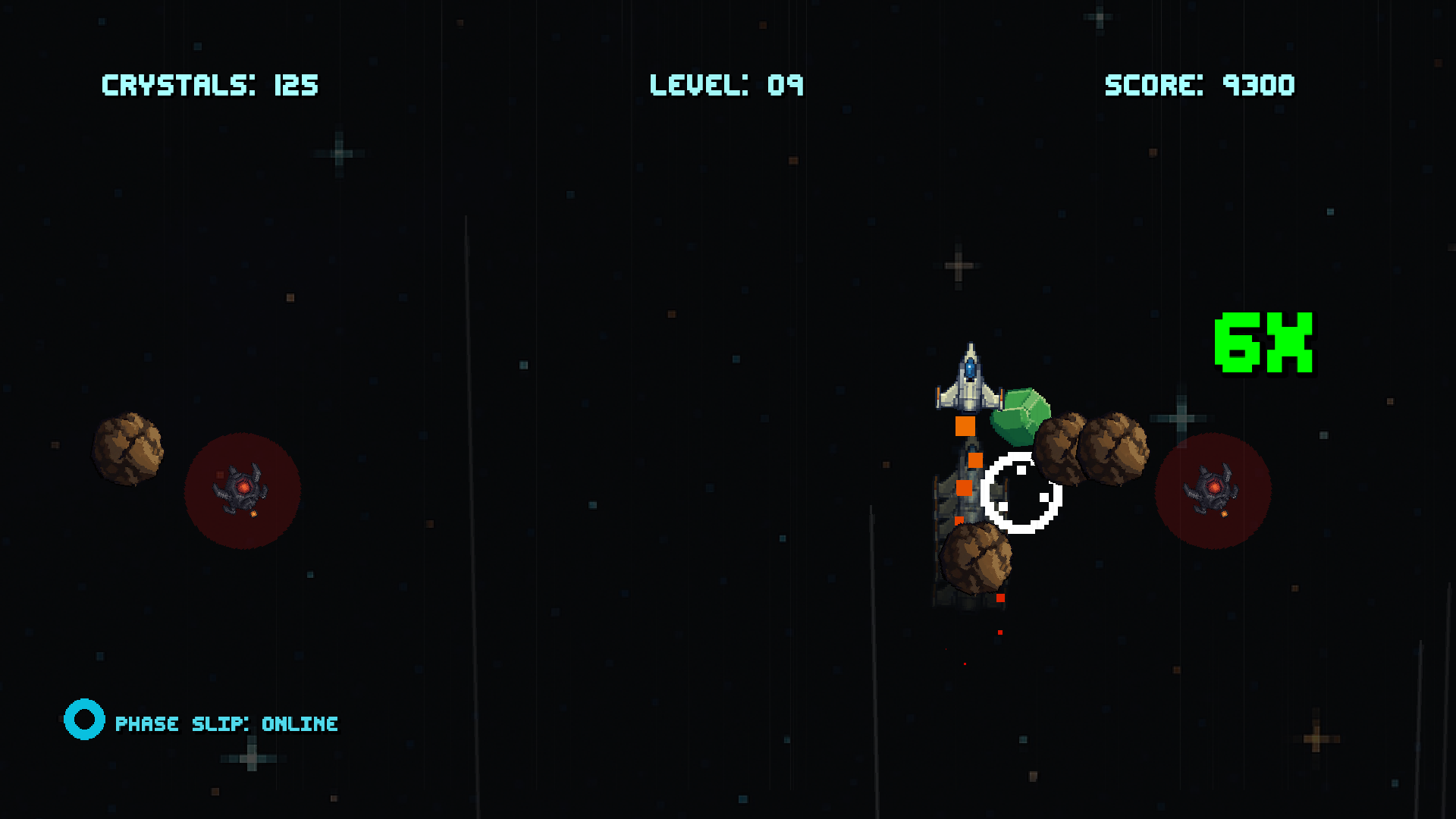
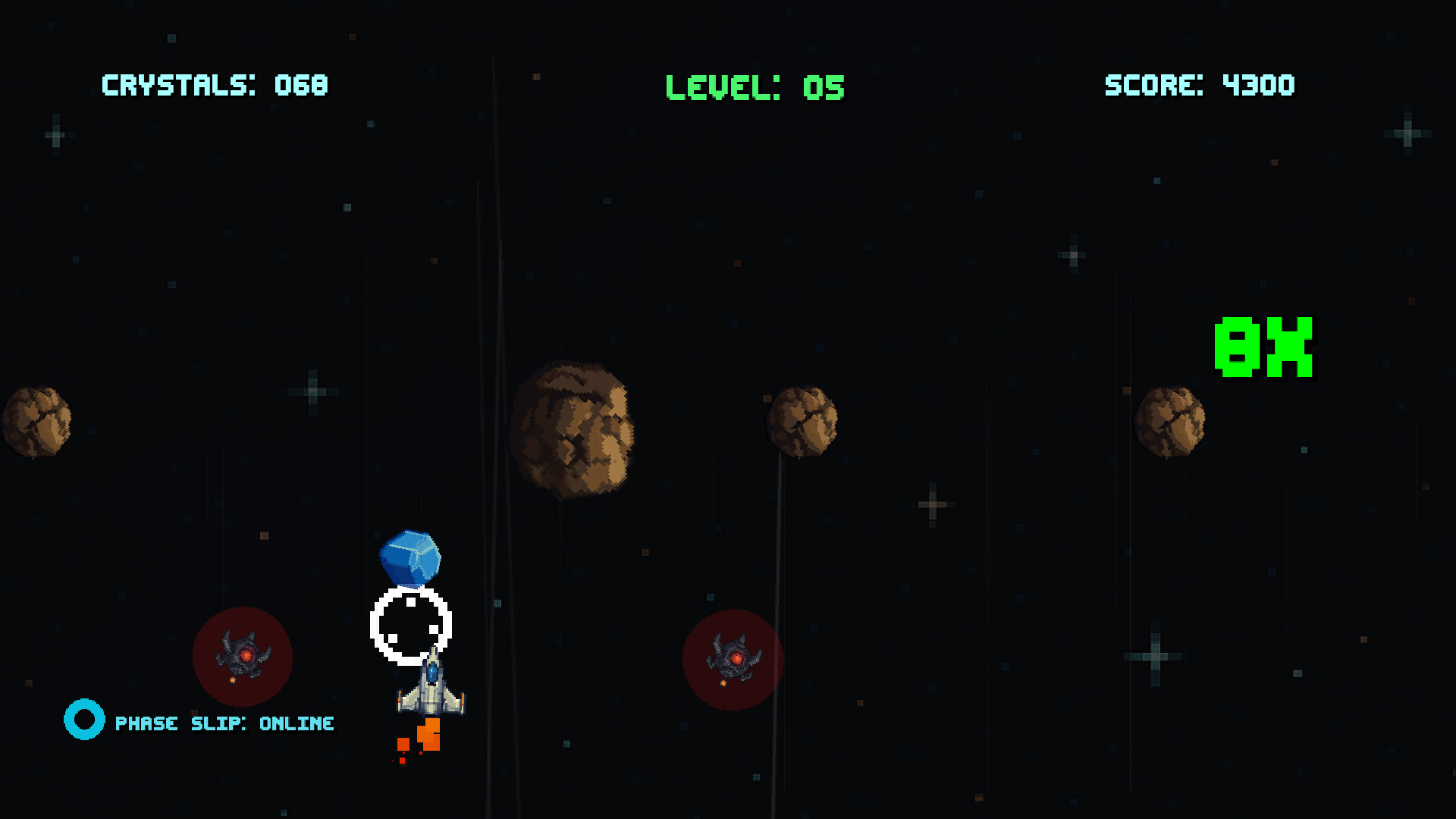
The core economy is a single overloaded object. Collecting a crystal advances four things at once: score, the combo, level progress and the dash. Missing one subtracts its full value from the crystal reserve, and if the reserve empties, the run ends. The same object is the reward and the survival resource, so greed is never optional - flying safe is a slow loss.
The combo expires five seconds after the last pickup and multiplies score up to six times on a hot streak. Stopping to play safe isn't a neutral choice; it's a decaying one. The multiplier is what turns collection into movement, because covering the spawn spread means crossing a screen the hazards are falling into.
The dash that rewards aggression
Phase Slip is a short invulnerable dash - 80 pixels in 0.15 seconds - on a three second cooldown. The rule that defines the game is that every collected crystal resets that cooldown to zero. Played timidly, the dash is rarely there when you need it. Played aggressively, it always is. The ideal rhythm is collect, dash through what you can't avoid, collect again - the game's defence is powered by its offence.
Selling the speed
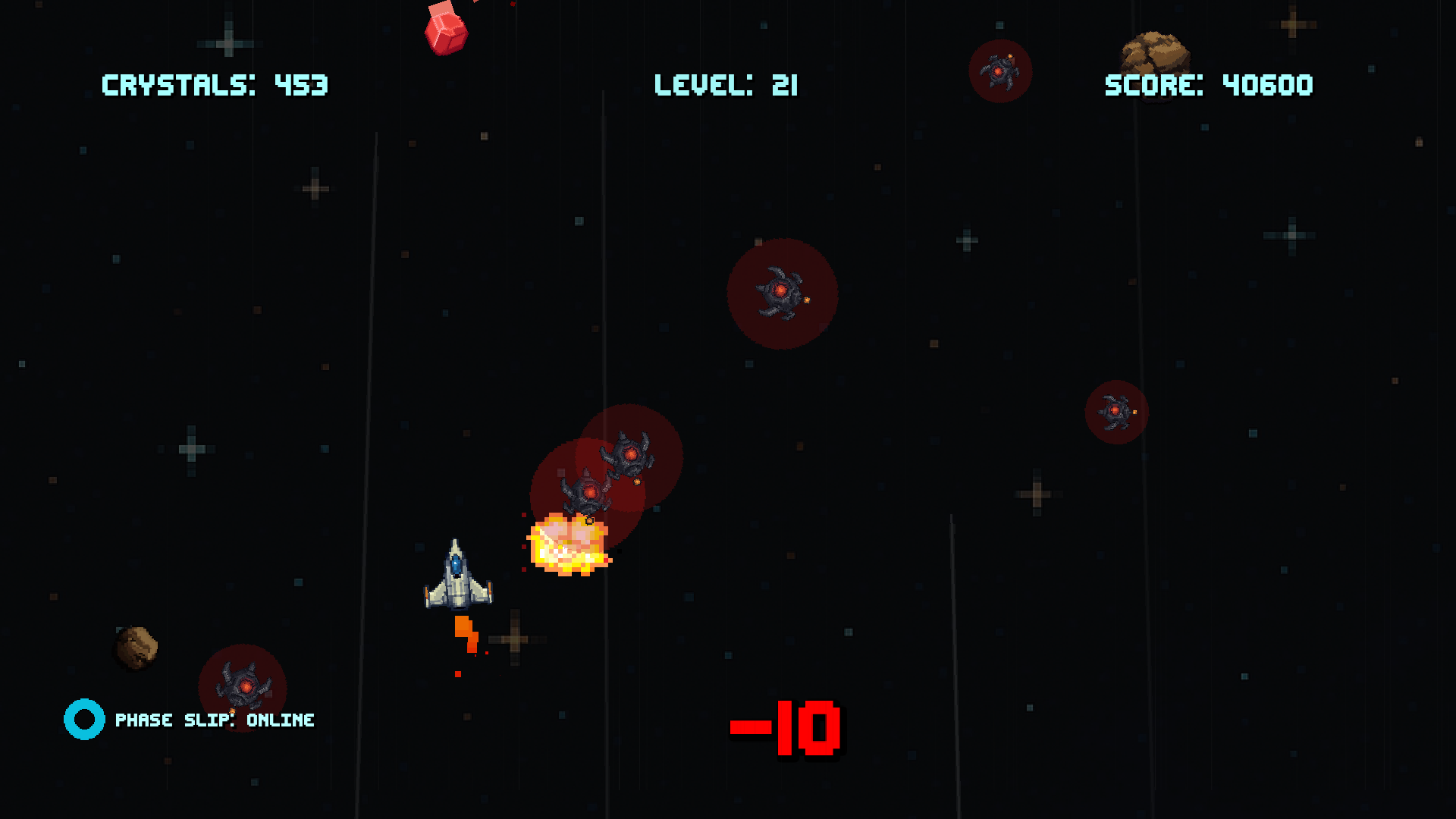
The sense of speed is mostly presentation, tuned until it read at a glance: the ship banks into turns, motion lines accelerate with every level, the star field scrolls faster as the run deepens, and pickups, misses and deaths each have their own shake, flash and controller rumble. The combo counter escalates through colour, scale and sparks at 5, 10, 25, 50 and 100, so a good run visibly heats up.
Underneath, the difficulty ramps to match: obstacle spawns accelerate toward a hard floor, mines telegraph and track, and patterned formations make you read routes instead of just reacting - lanes to choose instead of noise to survive.
Shipped, not shelved
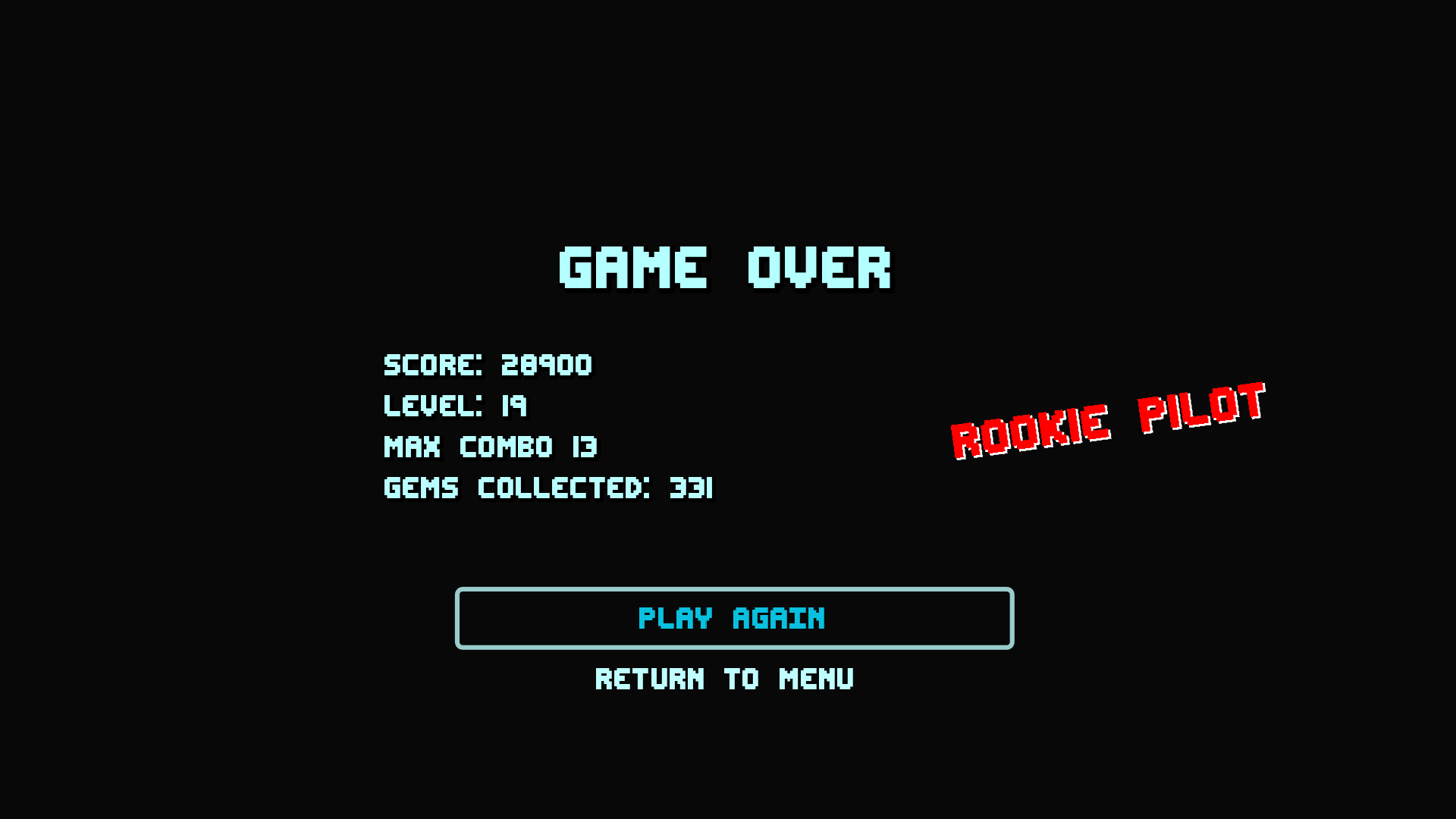
Finishing and shipping a small game teaches things an unfinished large one never does: what the last ten percent actually costs, how a game reads to someone who hasn't been staring at it for a month, and which ideas survive contact with a build. Crystal Drive shipped with three local pilot profiles, persistent records, playful result titles and an online top 20 leaderboard - a complete score attack loop, not a prototype.
It also proved the foundations. The combo timer, Phase Slip and the crystal-as-everything economy all came out of this three week box, and all three carried straight into Crystal Drive Z.